The down side of the tooth fairy: or, the note we wrote asking the tooth fairy to please kindly move along

If you’re short on attention, pictures at bottom

Have you ever found it odd that we tell our kids a fairy tale about someone who breaks into the house in the middle of night and steals teeth from under their pillows while we are sleeping?  If you have, you’re like my 6 year old who lost his first tooth today.

Like many of us, he processes the events of the day as goes to sleep.  And apparently the horror of the whole mafia-like forced-to-sell situation didn’t dawn on him until about 10 minutes after bedtime.

Enough time had passed that I thought he was fast asleep, and I was browsing reddit in my room on the other side of the house.  Our downstairs neighbors just had a baby, so when I heard muffled crying I assumed it was, per usual, the downstairs infant.

After a minute or so, as I sat judging the poor parenting of my neighbors who would let their child cry for so long, I noticed a familiar tone to the whelps and realized it was my own son.  (As an aside in my defense, he is now six, so crying doesn’t happen that often… and, there were some particularly interesting cat pictures on Reddit tonight…)

I arrive in my son’s room to find him sitting up on his bed, having completely covered himself in his blanked as a protective cave, crying like he was powerless to stop something he loved from being destroyed.

I sit down and start to comfort him and this is when we began our usual game of “wait wait, what’s wrong… yes, no, I don’t want to tell you.”  It’s not a game I particularly like, but he insists on playing and can’t be persuaded otherwise.

Dad: “Did you get hurt?

Blanket cave shakes side to side… I think that’s a no.

Dad: “Did your stuffed dog get hurt?”

Blanket cave shakes side to side… no chuckle at the stupidity of the question… bad sign…

Dad: “Do you miss Mommy (who is out getting dinner with a friend)?”

Blanket cave shakes side to side.

Dad: “Are you scared of something?”

Short pause, blanket cave shakes side to side… maybe there’s something there.

The peak of blanket cave mountain is lain upon my lap for comfort.

The crying subsides to a soft whimper and a sniffle.  A hand extends from blanket cave and points to the floor, then the window.

This is real progress!  I have absolutely.no.idea. what pointing at the floor then the window could mean, but the blanket cave is attempting to communicate!

Dad: “Did something fall down and break?”

Blanket cave sniffles, shakes side to side, then a child emerges, shuffles to the floor, points morosely to his colored pencil box, then to the window, and quickly re enters blanked cave.

This is the worst game of charades I have ever played.

Now, you have to imagine my puzzlement at this point.  You as the reader have the benefit of knowing that this is a story about the tooth fairy, and even with that advantage I’d bet that you’re having trouble figuring out what a colored pencil box and a window ledge have to do with dental-larceny.  I was clueless, and Gavin was still crying.

After a few more rounds of guessing, and some comforting, he saw that I didn’t get it and shuffled to the floor to get his pencil box.

Dad: “Did one of your pencils break?”

Child: “No”

Another major victory, we’ve established verbal communications!

Dad: “What’s wrong?”

Child: Opens pencil box, points to the middle, starts to mist up again, and manages a meek “my tooth.”

Dad: “What’s wrong with your tooth?”

At this point I see that he has hidden his tooth in the pencil box.  That’s a really great, if somewhat perplexing, hiding spot for a tooth.

Child: “I don’t want the tooth fairy to take it.” Full cry returns.

Usually epiphanies are great.  Finally seeing the pieces and how they fit together is usually an exhilarating feeling.  Not this time.  Sudden clarity that a pointless lie is causing substantial distress for your child is a horrible feeling.

I go along with Santa because I can see how much joy he gets from the ruse.  But this, this tiny imaginary winged woman stealing my kids stuff and making him cry, that’s not ok.  What does she even do with the teeth once she gets them?  This is suspicious behavior to say the least and I for one think we should contact TLC or the Easter Bunny about an intervention…

Dad: “Its ok honey, she doesn’t have to take it.”

Child: “But she needs them for her magic.”

This is the point where I get a bit mad.  F everything about this.  Who the *#@#$ @#$@# is feeding my kid these elaborate lies?

I briefly consider going full truth.  If you’ve ever tried to tell a tired, distraught child that they’ve been lied to and tricked, please let me know how that went.  He was still whimpering, and I couldn’t bring myself to make the world less magical on top of everything else he was dealing with.

So, I enter a phase known to anyone ever almost caught in a lie;  I try to extend the lie.

 “She doesn’t always need them for magic” “What about a paper tooth” “She can take it later if you want” “She gets lots of teeth, she doesn’t need yours if you want to keep it” “We can just write her a note”

Finally, the catch in his breath tells me he thinks something in what I’ve just said might work.  I see him looking at a stack of post-it notes… He’s processing how the note thing might work.

I start processing how the note thing might work — where do we leave this note, what does it say, we can’t leave it on the front door because we don’t know where she intends to break in, how do we even know she reads English?

I look at his stack of multi colored post it notes, the small Tupperware container the tooth, and the aforementioned colored pencil box, and I suddenly think I’m parenting-freaking-macguiever, and I might be able to defuse this bomb.

Dad: “OK, we can write her a note, we’ll just say ‘please don’t take my tooth'”

Child: lip still quivering slightly, “You write it”

Dad: “OK”

Child: “I’ll sign it, so she knows its from me”

Crayola pencil and pink post it note in hand, I start writing a note to the tooth fairy.

Tooth Fairy,

Please leave my tooth here.

Child signs his name in the most adorable mixed case.

We put the post-it note on top of the case, put the case in the window (apparently he’s been told that tooth fairies use windows when they decide to break-and-enter), and his crying stops.

He asks for and gets another story and finally goes back to sleep.

A few pictures of the anti-dental-theft apparatus we rigged up:
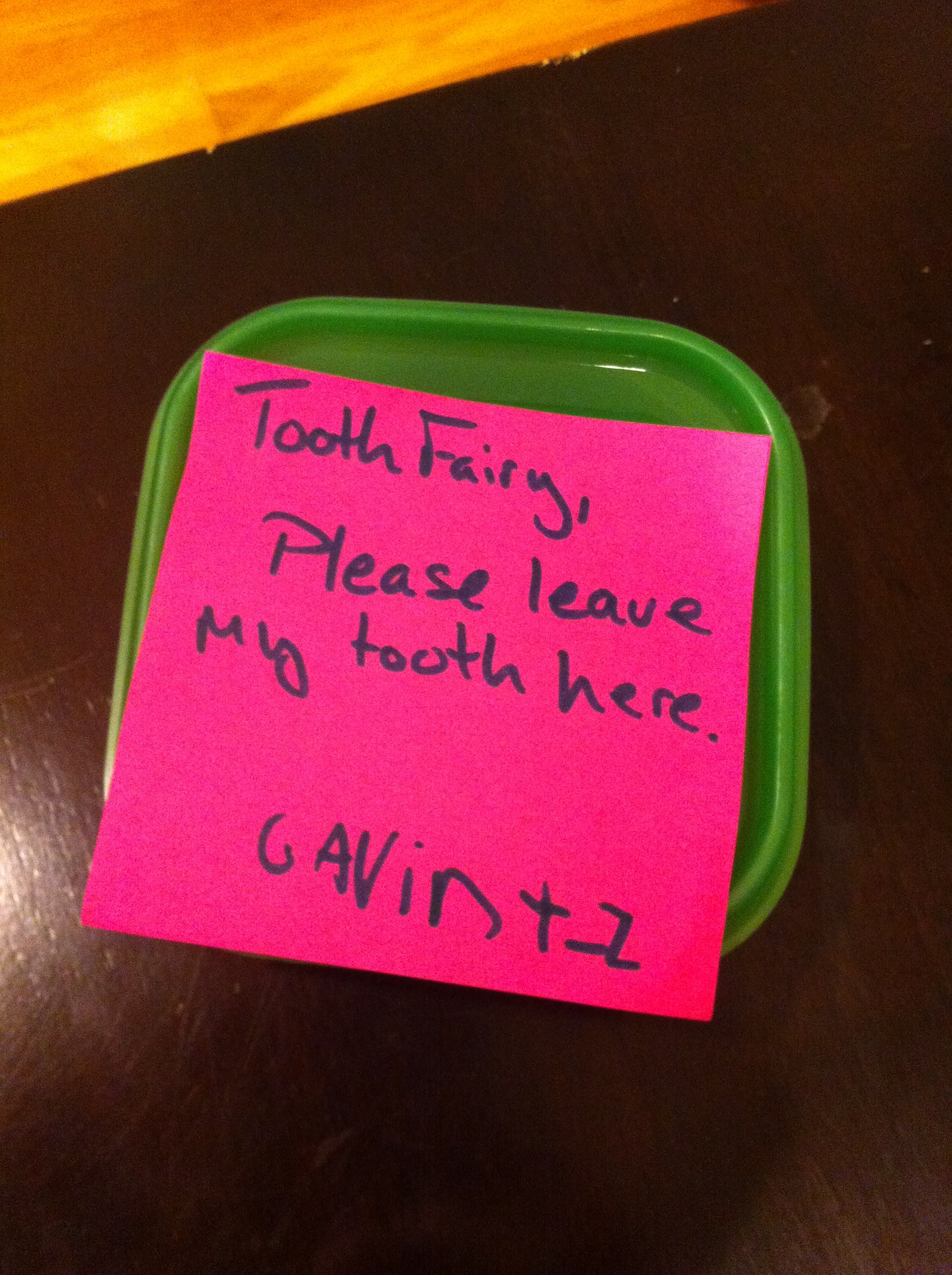
Tooth Fairy Anti Larceny: Exhibit A
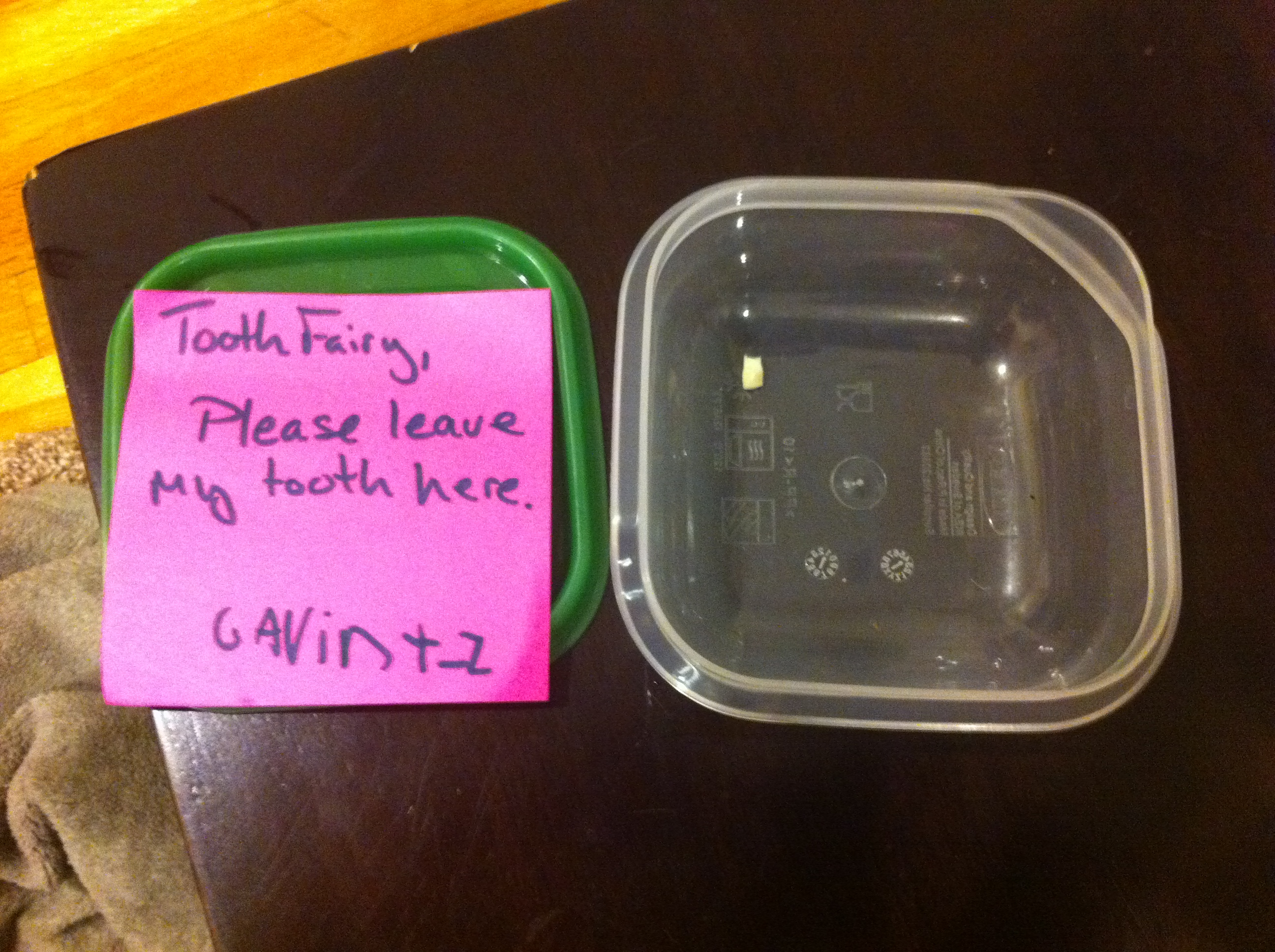
Tooth Fairy Anti Larceny: Exhibit A


Tooth Fairy Anti Larceny Note: Exhibit B
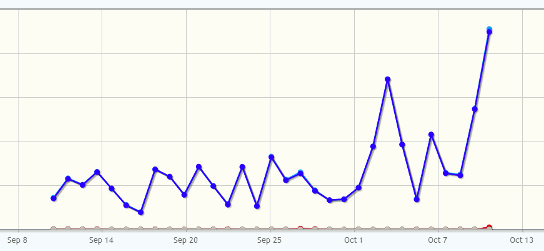
 

Teaching Charts to a 5 Year Old

Earlier today, I left my site statistics window open at the dining room table as I went to get Gavin a cup of apple juice.  As I was in the kitchen I heard from the dining room “Daddy, I like your painting.”  Not having painted anything in about 15 years,  I didn’t know what he meant.

Returning to the dining room, apple juice in hand, I saw him sitting in my chair happily appreciating the artistic merits of the chart of emails sent by day over the past month.  I like the chart too, because it shows that SittingAround is growing.

My “Painting,” or notification emails sent by day for the past month.

Realizing that he’d never been exposed to visual representations of information before, I though it would be a good idea to give him a quick primer.  I expected his attention would last maybe three sentences.  Six charts in, having shown him bar charts, spider graphs, x-y plots, and pie charts, I realized he was more interested so I started to probe on understanding.

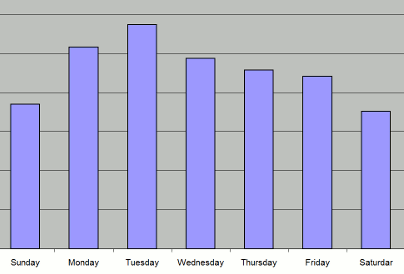
I showed him this bar chart and asked, “Which day do you think we have the most signups?”

SittingAround User Signups by Day

Instant and correct answer: “Tuesday.”

So I showed him another chart and asked “Why do you think they call this a spider-graph.”  This time answering like I was a bit of a simpleton, he says in his explain-simple-concepts-to-my-parents voice “because it looks like a spider web.”

Touche kindergarten child, touche.  Perhaps I’ve underestimated you.

I ask if he’d like to make his own charts, which gets an excited jumping up and down yes.  About twenty minutes and three charts later he clearly felt like he’d mastered the topic and was ready to move on to blowing bubbles on the deck.  The following are the charts that we created this afternoon.

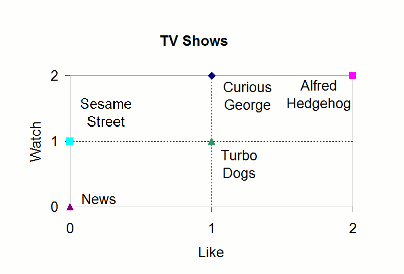
TV Shows, using a simplified X-Y axis

TV Shows Gavin Likes vs. How often he gets to watch them
Data Table for TV Shows Gavin Likes

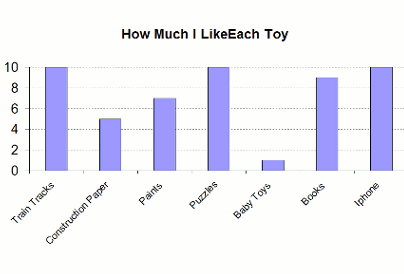
Toy preferences, using a simple bar chart

Scale of 1-10 how much Gavin likes each toy. Notice how he considers my Iphone to be one of his toys.
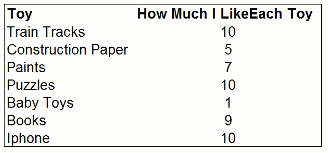
Data Table for Toys Gavin Likes

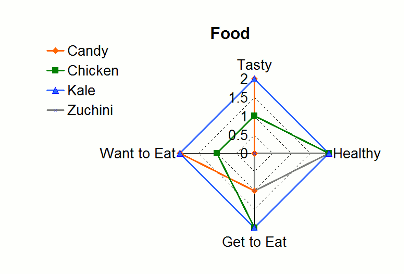
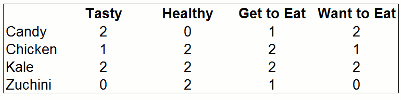
Food, using a four factor spider graph

Gavin’s Take on different foods. I think this one is my favorite. Notice how we have somehow convinced him that Kale is the perfect food. Secret to that, I think, is lots of galic and olive oil.
Data Table for Gavin’s take on foods


Gavin’s Summary:
Q: What did you think about daddy showing you charts today?
A: “Awesome, Awesome”

Q: What was your favorite chart?
A: “I think toys, yeah, toys, toys toys”

Q: What is a chart?
A: “I don’t know but I made a chart at school today.  Its just a plain old chart, you know, number charts daddy.”

I’m a big proponent of explaining things to kids that are beyond what I think they can understand.  I figure it primes them to the basic concepts and words for the next time they are exposed to the idea.  It also has the advantage of occasionally finding an area where my son’s comprehension is way beyond what I expect it to be, like happened today.

If you’d like to try this with your own kids, the excel file we used to make these charts is available here.  Gavin 5 year old charts.xls

Lack of Daycare Hits European Families Hard

These are the kinds of stories that break our hearts.

In the past few days, a number of articles have popped up in newspapers worldwide analyzing the rising cost and dwindling availability of childcare. Reports from the United Kingdom lament the fact that the cost of nannies and daycare centers have forced a growing number of families to have one parent leave the workforce to stay at home with the children. Sadly, in Germany, in addition to facing the same rising costs as the UK, parents are facing a childcare and early education crisis that is affecting more than just incomes.

An article published earlier this year explains how the fall of the Berlin Wall led to an influx in the number of children vying for spots in state-assisted childcare centers. As a result, soaring costs and limited availability (about 23% of children under 3 yo are in daycare, despite a much greater demand for it) are making it so difficult for parents to balance work and home that the birthrate has actually declined in the last 10 years and the trend is expected to continue.

The whole driving force behind SittingAround.com is our desire to help improve the situation of parents everywhere, so of course we find it sad to think that a lack of balance may be causing people to delay or forgo having children. One proposed solution to the problem is an advance akin to a student loan (as if parents need to pay a college tuition twice!) and there have also been rumblings in the UK about changing the laws to give parents more discretion concerning childcare, which will hopefully increase options. In any case, it will certainly be interesting to see how these countries will look to solve the childcare cost/availability issue in the future and we’ll be keeping our fingers cross for affected parents during this stressful time.

7 Innovative Ways to Make Parenting Better!

Here at SittingAround, our goal is “to make parents’ lives better.” This goal influences everything we do, from the way we’ve designed our site to how we engage with you, our customers. In addition to making SittingAround everything you want it to be, we’re also always on the lookout for other products and services that will make your life easier, simpler, more rewarding – better.

We’re excited to present six other innovative family products that we think you will love!

  • Company: Swellr
  • Site: http://swellr.com
  • Problem it Solves: School funding
  • Overview: Swellr is an online marketplace to fund education needs by shopping local. A PTA group can raise money for their school by creating a project on Swellr. A project could include school supplies, field trip costs, guest speakers or miscellaneous costs for an end of the year party for students. Each project organizer then asks their friends and family to buy gift certificates from participating businesses on swellr.com, and a percentage of each purchase goes to the project of the consumer’s choice. It’s a great way harness local spending power to boost investment in local business and education.
  • Company: Speedbump
  • Site: http://speedbumpgps.com
  • Problem it Solves: Teen driver safety
  • Overview: an Android app that keeps your teens safe on the road. Unlike other driving safety solutions, the Speedbump application – easily downloaded onto a teen’s Android phone –provides parents with instant alerts about both driving speed and driving patterns. Their unique SpeedSmart™ technology lets users set and detect realistic speed limits on any type of road – residential, secondary and highway. Created by a teen for teens, Speedbump encourages a dialogue between teens and parents about driving safety and protects teen privacy while providing the parents with peace of mind.
  • Company: Casa Couture
  • Site: http://casacoutureinc.com
  • Problem it Solves: Children’s ever-changing shoe size
  • Overview: Casa Couture has developed a patented “Growth Indicator” technology that can be used in the construction of children’s shoes to alert a parent when the child has outgrown his or her shoes. Outgrown shoes are uncomfortable, unhealthy and bad for a child’s feet. This innovative technology is designed with a child’s comfort and healthy foot growth in mind. These shoes will accommodate up to three whole sizes, saving parents from having to replace their kid’s shoes every 2 to 3 months.
  • Company: Lynx
  • Site: http://lynxsportswear.com
  • Problem it Solves: Post-baby breast support
  • Overview:: Lynx Sportswear makes sports bras for larger-breasted women that actually work! The Lynx Sports Bra was created by a large breasted woman, Cynthia Smith, who started running after her son was born as a way to get back into shape. After more than a decade of trying every sports bra on the market without success, she took matters into her own hands and made a sports bra that eliminates bounce without causing any pain or discomfort. Cynthia is passionate about helping other women feel strong and capable, no matter what their breast size!
  • Company: GoGaga
  • Site: http://gogagalife.com
  • Problem it Solves: Toting heavy, uncomfortable diaper bags
  • Overview: At Go GaGa, we create diaper bags and straps that are comfortable no matter what you’re carrying. Our patent pending strap is the secret to our bags’ style and comfort – it’s a wide swath of stretch fabric spreads the weight across your back and shoulders, so there’s nothing cutting into your neck or pulling you to one side. Plus, our diaper bags feature stroller straps, insulated bottle packets, a changing pad and 10 pockets to make it easier and more enjoyable to travel with your little one, whether across town or across the country. To learn more about our products, visit www.gogagalife.com
  • Company: thredUP
  • Site: http://thredup.com
  • Problem it Solves: Children outgrowing clothing
  • Overview: Kids grow fast. By age 17 your child has outgrown 1,360 pieces of clothing. Worse yet, you’ve spent upwards of $20,000 replacing clothes that are practically new. What if you could easily trade all that outgrown clothing for sizes you actually need? thredUP is where moms swap children’s clothing, toys and books online. thredUP connects thousands of moms across America and facilitates simple trades. For the first time, parents can exchange boxes of kids’ outgrown clothing, for boxes of clothes that fit – without ever leaving the house.

And, in case you’re new to SittingAround, a little about us, too:

  • Company: SittingAround
  • Site: http://sittingaround.com
  • Problem it Solves: Childcare
  • Overview: SittingAround is childcare, made better. SittingAround revives the notion that “it takes a village” in a modern way, through babysitting coops. By trading sitting with each other, families who participate in a coop provide each other with not just care but the social support parents today so often lack (yet so desperately need). SittingAround makes it easy for families to start and run their own babysitting coops and transforms the way parents think about childcare.

Babysitting Coops Already Saving Families Over $100,000 Per Year

We opened SittingAround.com to the public less than a month ago, and already families using our site are saving over $100,000 a year.

There are over 500 families participating in over 100 coops on SittingAround.com today. Based on the use we’ve seen so far, families who are participating in coops will save between $100 and $500 per year, with an average savings of around $250 per year. Multiply $250 by 500 families and we get an annual savings of $125,000 per year!

While we’re very happy with the growth of coops so far, we’re just getting started. We want to bring coops to as many families across the globe as possible and change the way families think about childcare. Our goal is to have 100,000 families and 10,000 cooperatives by the end of 2012.

Coops save families money by eliminating the need for paid babysitters. Instead, families receive free babysitting from other parents in exchange for returning the favor. While coops have existed for many years, until recently they have been difficult to coordinate and manage. SittingAround makes coops easy and, in doing so, helps families across the world save on the cost of childcare.

Paid Parental Leave: Is Having a Baby a Luxury?

How much time did you take off when your kids were born?

For me, it was four weeks. Two weeks paid by my employer and another two weeks that was comprised of every possible vacation/sick day I had. By American standards, that’s not too bad. By most other standards, though, it is.

First, those paid weeks that I took are not guaranteed to me under any federal law. According to the Family and Medical Leave Act (FMLA), new moms may take up to 12 weeks off, but that time is unpaid. Employers are not mandated to pay for any maternity leave, they simply have to allow new moms to take it. While I appreciate the FMLA, I don’t think it goes far enough. For most families, a 12-week unpaid leave is a luxury they can’t easily afford.

Compare this with our neighbors to the north and the south. Canadians enjoy a notoriously generous parental leave policy, receiving an entire year at 55% of their salary. Mexicans are guaranteed a lesser 12 weeks off but at a full 100% pay. And, should you venture to Europe, you’d find that many countries there offer a year — or more! — for new parents to care for their children.

As both a mother and a professional, the American parental leave laws are near and dear to my heart. By having such stringent policies, we are, in effect, forcing women to choose between spending critical months with their babies and furthering their careers. For many, financial considerations don’t even allow women to choose — it’s work or you can’t pay the bills.

I think the FMLA could use an overhaul. Thankfully, so do a lot of other people as well. If you’re interested in getting involved in this and other issues affecting families, check out Mom’s Rising, an advocacy group working to build a more family-friendly America.

SittingAround is Open (and Free Before 6/30!)

I’m happy to announce that SittingAround is now open to everyone! We opened the site up earlier this month (we had been invitation-only for a while) and are so excited to have so many new coops using our service! To celebrate our launch, all accounts created before June 30, 2011 will be free for life!

Here’s our recent press release:

For Immediate Release
June 2, 2011

SittingAround.com Launches Innovative Babysitting Site

SEATTLE, WA — June 2, 2011 —SittingAround.com, an innovative new option for childcare, launched to the public on Wednesday, June 1st. By making a well-run babysitting cooperative accessible to anyone with an internet connection, SittingAround will dramatically improve the way Americans consume childcare and save the average family $500 per year.

To celebrate its launch, SittingAround is waiving its $15 annual subscription fee for everyone who signs up prior to June 30th and giving those users free site access for the life of their account.

What’s A Coop?
Babysitting coops (pronounced co-ops) are small groups of parents in a neighborhood who trade babysitting, taking turns watching each other’s children. Often, coops are comprised of parents whose children go to the same daycare or school. Because each coop chooses who may join, parents only trade sitting with other parents they know and trust.

“For most parents, this is a brand-new concept,” says Erica Zidel, Founder and CEO. “Less than a quarter of parents are familiar with coops, 1 but when you tell them that there is a way to get free, easy to coordinate, high quality babysitting, their eyes light up. We want to tell as many parents as possible that coops are a great option for childcare.”

A Website that Make Coops Easy
While the basic concept of coops is simple, there is a lot of administrative work required to run a coop successfully: tracking points, scheduling sits and meetings, vetting new members,
maintaining current member contact info, etc. “When you manage a coop on SittingAround.com, our software automates the administrative tasks for you,” says Zidel. “Our site lets parents enjoy the benefits of a well-run cooperative without the hassle.”

SittingAround.com makes it easy to start, manage, and grow babysitting cooperatives.

Biggest Threat to Family Finances? It’s Childcare.

Everyone knows childcare is expensive. But some may be shocked to learn just how expensive it is and the enormous threat it poses to the family finances.

According to a recent Washington University in St. Louis study, the cost of quality childcare is the greatest threat to families’ financial security. Childcare makes up the single greatest portion of the average family’s monthly expenses — families spend more each month on childcare than they do on housing!

“Childcare is so expensive that income needs for a one-parent family with two preschoolers are equivalent to those of a one-parent family with five teenagers,” states the report.

It’s no surprise that families are looking for ways to save on childcare costs without comprising the quality of care their kids receive. Savvy parents are seeking alternative arrangements, such as nanny shares during the week and babysitting coops at night and on the weekends.

What are your thoughts on the dramatic costs of childcare? Have these costs put your own finances at risk?

How much does the average family spend on babysitting?

Simple Question.

It seems like a simple question, doesn’t it?

But it’s Not.

If you want the results without a long story on why we did the research ourselves, scroll down to the fourth heading.

In 2010, when we wanted to figure out how much families could save by joining a coop, we went to trusty Google to try to get an answer to this question, fully expecting that it would be a 5 minute exercise and we could move on.

After about an hour of searching, the best answer we could find was a USDA report that lumped all childcare and education together – daycare + babysitting + private schools + college + SAT tutors. I didn’t think that we could justifiably say that joining a coop would reduce the cost of college, so we were at an impasse. We wanted to start a website to save families money on babysitting, but we couldn’t figure out how much families were actually spending.

After another three hours, I could confidently say that, on average, families were spending at least $1 and less than $5,000 per year on babysitters. I’m pretty good at working with bad data, triangulating, being creative to find a reasonable range, but there’s seriously nothing out there to work with. $1 to $5000 just isn’t specific enough to build a business case. I not so quietly gave up hope of finding out how many families are currently using coops, or even how many families were using babysitters.

The babysitter’s club is not doing their job as an industry association. Its like the entire industry is run by teenagers.

Ok, We’ll do the Research

Luckily, my co-founder has a bit of a background in statistical research. She pulled together a user friendly survey, a methodology that makes our results fairly valid given the limited budget ($0) we had to conduct the survey, and took to the mommy blogs to try to get an answer. (It helps that she has a mommy blog herself.)

The Results

What’s that? You wanted information on babysitting, not a long story about market research. You don’t find standard deviations and response biases fascinating? Really? Ok, ok, I’ll get to the results.

It turns out that the average American family spends about $500 per year on babysitters. The actual average in our survey was $462. Given sample size, methodology, sampling biases, etc we should really say that the average family spends about $462 on babysitting. To me that’s close enough to saying “about $500” that I go ahead and round it, but if that’s not your style feel free to mentally replace $462 everywhere I use $500.

The average family spends about $500 on babysitting. Alone, its a pretty interesting number: 5 hundred dollar bills, half of a thousand, more than my son gets in allowance each year. But, lets see if we can put that number into better perspective.

  1. The average family makes about $50,000 per year. That means they’re spending about 1% of their income on sitters. The average family saves 4% of their income each year – 1% isn’t a negligible amount.
  2. The average sitter costs around $10 an hour. So that means the average family consumes about 50 hours of babysitting a year. If the average night out is 4 hours, that means the average family has a night away from the kids about once a month.
  3. The more a family makes, the more they spend on sitters. The lowest income group in our survey reported an average spend of $350, the highest income group reported an average spend of $740.
  4. $500 per year in a college fund would be over $22,000 by the time your kid goes to college. (assumes you save $500 each year stopping when the child is 13, the child goes to college at 18, and an average annual rate of return of 10%)